

News and Trends
A4 Printer Government Self-Service Board for Certificate Printing, WF-S3399, AndroidSBC, Tokyo
TL;DR: A4 Printer Government Self-Service Board for Certificate Printing
AndroidSBC software desk: Android 15 baseline and staged OTA channel published for the WF-S family serving Tokyo, Japan. The WF-S3399 government service kiosk Android motherboard spans the dual-screen high definition service terminal and eleven sister models in the WF-S series, all built on the RK3399 dual Cortex-A72 1.8GHz plus quad Cortex-A53 SoC with the ARM Mali-T860 MP4 GPU, dual 4K output, HDMI plus eDP, and Android 11 firmware support. AndroidSBC, the export arm of Wanlin Manufacturing Group, ships the WF-S family from the Longgang source factory in Shenzhen to Tokyo and Japan importers who run citizen service hall, tax and social security counter, certificate printing, identity verification, public information display and outdoor smart city programmes.
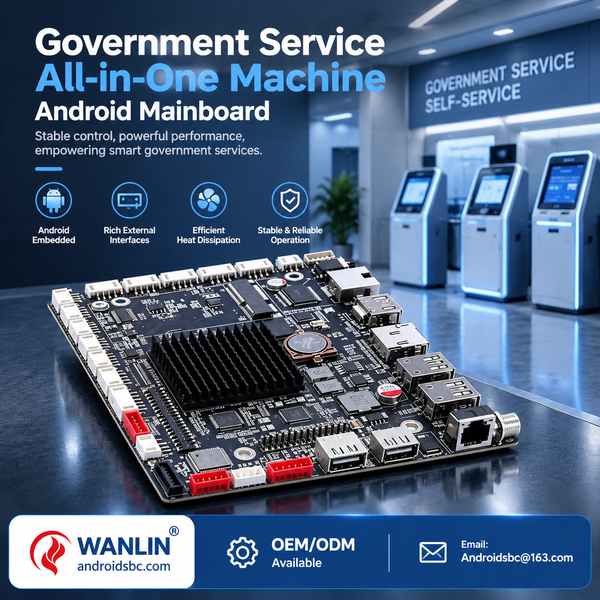
About AndroidSBC and the Government Service Kiosk Android Motherboard Family
The export desk at AndroidSBC handles Tokyo and Japan programmes on three commercial tracks and one technical baseline. Whether the partner wants a branded catalogue SKU, a custom carrier board or regional distribution rights, the board underneath is the same WF-S platform with the same driver package and the same update window. Certification, carton labelling and palletisation for Japan are prepared in Shenzhen by the export desk before the Tokyo shipment leaves, and the test reports stay versioned against the board revision.
WF-S3399 Technical Specifications
| Parameter | AndroidSBC WF-S3399 (dual-screen high definition service terminal) | Industry Average |
|---|---|---|
| Processor | RK3399 dual Cortex-A72 1.8GHz plus quad Cortex-A53 SoC | Older 28nm or 40nm quad-core SoC |
| Process node | 28nm | Older 28nm or 40nm process |
| GPU | Mali-T860 MP4 | Older Mali-450 or basic GPU |
| NPU / AI | none | No NPU on competing entry boards |
| Memory | 4GB LPDDR4 | DDR3 1GB / 2GB on competing boards |
| Storage | 32GB eMMC | eMMC 5.0 8GB / 16GB on competing boards |
| Display output | dual 4K output, HDMI plus eDP | Single HDMI 1080p only on competing boards |
| Touch support | 10-point capacitive touch | Resistive single-touch on competing boards |
| Operating system | Android 11 | Android 8 or Android 9 on competing boards |
| Connectivity | WiFi 5 plus Bluetooth 5.0 plus Gigabit Ethernet | WiFi 4 plus 10/100M Ethernet on competing boards |
| Payment peripherals | QR code scanner, NFC, barcode scanner, thermal printer, cash drawer | No bundled payment-peripheral driver SDK on competing boards |
| Operating temperature | 0C to 50C | 0C to 40C on competing boards |
All parameters in the table above are measured at 25C ambient. The AndroidSBC WF-S3399 (dual-screen high definition service terminal) maintains its 4K HDMI output plus capacitive touch sampling while running the burn-in test loop, a configuration that competing single-platform boards cannot sustain at 60fps. For Japan importers sourcing the WF-S family, the WF-S3399-A variant is the typical configuration for the high resolution citizen information terminal use case, with a sustained weekly capacity of 5000 pcs/wk.
Challenges in Sourcing Government Service Kiosk Android Motherboards for Japan Buyers
Peripheral integration eats the schedule on most Tokyo rollouts. The ID card reader, the fingerprint module, the thermal printer and the document scanner each arrive with their own driver, and reconciling four vendor SDKs on one Android image is where a two-week plan becomes a two-month plan.
For identity work AndroidSBC wires the trust chain at board level: secure boot, a trusted execution environment, hardware-backed key storage and an audit log that survives a power cycle, which is what a Japan acceptance test asks to see. AndroidSBC has now closed the 9th consecutive quarterly window on this family, with 91100 boards scheduled for Tokyo and Japan on the Tokyo - Shanghai lane as of September 20, 2026.
Competitive Comparison: WF-S3399 vs Competing Government Service Kiosk Android Boards
AndroidSBC writes these comparisons into Tokyo tender responses because they answer the question behind the question: not whether the board works, but whether the programme survives a staff change, a budget cycle and a firmware update.
- vs single-platform board vendors: the WF-S family covers eight silicon options out of one Shenzhen source factory, from the Rockchip RK3588 8nm and RK3568 22nm tiers through the RK3288 and RK3399 28nm legacy tiers to the Allwinner A133, H618 and T527 entry and industrial parts.
- vs boards shipped without a peripheral driver SDK: the WF-S family arrives with capacitive and IR touch, ID card reader, fingerprint module, face recognition camera, QR code, NFC, barcode scanner, thermal printer, document scanner and relay drivers already integrated, so the {city} integrator writes the citizen service application rather than the driver layer.
- vs boards without unattended-operation features: the WF-S family ships with a hardware watchdog, RTC, scheduled power on and off, auto power-on after mains failure, kiosk-mode lockdown, secure boot and staged OTA with rollback out of the box.
- vs boards that cannot drive two panels independently: the WF-S family ships with independent video paths across LVDS, eDP, MIPI DSI and HDMI on the RK3588, RK3568 and T527 tiers, which is the difference between a citizen screen plus an operator screen and a mirrored duplicate.
Global Government Self-Service / Citizen Service / Public Information Terminal Market Trends
Hardware carries the majority of public-sector self-service kiosk revenue, which is why dual-screen high definition service terminal programmes in Japan are decided at board level rather than at software level, and why Tokyo integrators qualify silicon before they qualify applications.
- Citizen service halls and municipal counters: WF-S3399 is the usual starting point for hall rollouts, with the dual-screen WF-S3601 as the citizen plus operator option.
- Tax, social security and housing fund terminals: the mid-tier WF-S3601 and the printing-capable WF-S3602 sister SKUs form the counter ladder, with certificate printing and queue management.
- Outdoor and 24-hour unattended cabinets: WF-S3602 and the industrial sister SKUs cover continuous-operation municipal self-service points across a city estate.
AndroidSBC shares the source tables behind these figures with Tokyo and Japan integrators on request, including the segment splits used for planning.
Partner Success Story: Kanto Public Service Systems (municipal terminal integrator)
The Kanto Public Service Systems rollout in the Japan government segment shows how the WF-S family from AndroidSBC supports Tokyo integrators. Kanto Public Service Systems installed 91100 WF-S service boards across ward offices, residence registration counters and certificate issuing points.
- OEM relationship: AndroidSBC private-label SKU shipped with Kanto Public Service Systems branding and CE / FCC / RoHS files bundled.
- Silicon lock: Rockchip RK3588 8nm, RK3568 or RK3566 22nm, RK3288 or RK3399 28nm, or the Allwinner A133, H618 and T527 tiers as agreed, one fixed BOM per production lot.
- Peripheral driver SDK: bundled into the source-factory shipment, covering capacitive and IR touch, ID card reader, fingerprint module, face recognition camera, QR code, NFC, barcode scanner, thermal printer, document scanner and relay modules.
- Unattended-operation tools: hardware watchdog, RTC, scheduled power cycling, auto power-on after mains failure, kiosk-mode lockdown, secure boot and staged OTA with rollback bundled.
- Compliance paperwork: CE / FCC / RoHS plus METI / MIC conformity, all bundled into the Shenzhen source-factory shipment.
In the words of Kanto Public Service Systems Platform Lead for Japan Government: Kanto Public Service Systems runs unattended certificate issuing points, so the hardware watchdog, scheduled power cycling and staged OTA on the WF-S board removed a whole class of site visits for the 91100 terminals now live in Tokyo.
Field Report: dual-screen information terminal rollout at a public security service hall
SHENZHEN, September 20, 2026 - Dai Lin, AndroidSBC field desk. The WF-S3399 lot shipped with the dual-screen high definition service terminal image pre-flashed and kiosk-mode lockdown verified, which removed a day of on-site work for the Japan integrator. The WF-S3399 government service kiosk Android motherboard order for Tokyo, Japan cleared the burn-in station on schedule and is en route via the Tokyo - Shanghai lane.
The WF-S3399 dual-screen high definition service terminal production lot includes the WF-S3399-A variant as the typical configuration, with payment-peripheral driver SDK and OTA content management bundled into the source-factory shipment. For Japan integrators, the METI / MIC conformity plus PSE under the DENAN law with the MIC Giteki mark paperwork is bundled.
Filed by Dai Lin, AndroidSBC field desk, SHENZHEN. PSE plus MIC Giteki; municipal certificate issuing terminals require Japanese-language UI firmware and 100V power compliance.
WF-S3399 Application Scenarios
The WF-S3399 dual-screen high definition service terminal sits inside a twelve-variant WF-S government service kiosk Android motherboard family from AndroidSBC, a Wanlin Manufacturing Group export brand. The WF-S3399-A configuration is the typical build for the high resolution citizen information terminal use case, with identity peripheral driver SDK and staged OTA management bundled.
- Citizen service hall enquiry and queue points: WF-S3399 plus WF-S1331 form the hall entry ladder, with independent dual display output and 4K HDMI.
- Tax, social security and housing fund counters: WF-S1331 plus WF-S6180 are the usual pairing where certificate printing and ID verification run on the same board.
- Immigration and public security checkpoints: WF-S6180 is the dedicated secure identity SKU, with secure boot, trusted execution and an audit trail that survives a power cycle.
- AI identity verification and face recognition terminals: WF-S5270 plus WF-S8800 cover the vision and verification workload on the device.
- Community and neighbourhood service desks: the compact WF-S3399 and the entry-tier sister SKUs serve walk-in enquiry where counter space is limited.
- Outdoor and semi-outdoor municipal cabinets: the industrial T527 sister SKU takes the 24-hour unattended points that see a full seasonal temperature range in Tokyo.
- Hall notice and announcement networks: the H618 and A133 sister SKUs drive continuous-play public information screens across a Tokyo building estate.
- Document scanning and form filling terminals: WF-S8800 plus WF-S1331 pair the scanner and the signature pad on one board for the Tokyo administration.
- Legacy estate refresh programmes: the RK3288 and RK3399 sister SKUs match the mechanical and electrical footprint of existing Tokyo hall terminals, so a refresh does not become a redesign.
Partnership Models for Tokyo Buyers
The WF-S family ships on three commercial tracks for Tokyo and Japan: a branded catalogue SKU, a custom design, or regional distribution rights.
- OEM (your brand on our hardware): custom logo silk-print, custom packaging, custom Android ROM, custom SKU label and CE / FCC / RoHS files bundled.
- ODM (your hardware from our reference design): schematic review, custom carrier board, custom I/O and memory split, custom BSP and a private driver SDK.
- Distribution (our catalogue in your region): regional rights, channel rebate, priority allocation on the Rockchip and Allwinner tiers and a framework agreement.
All three tracks run on the same twelve-model WF-S family and the same Longgang production line, so Tokyo partners can move between them without re-qualifying the platform for Japan.
Frequently Asked Questions
Does the WF-S government service kiosk Android motherboard family support a dual-screen high definition service terminal?
Answer: Yes. The dual-screen high definition service terminal is covered by the standard WF-S driver SDK, which means the Tokyo integrator configures it rather than ports it.
What is the real difference between the RK3399 tier and the other silicon tiers in the WF-S family?
Answer: The RK3399 choice is mostly about workload. Notice screens and enquiry points do not need it, dual-screen counters usually do, and AI identity verification terminals need the RK3588 tier specifically. AndroidSBC publishes the mapping and Tokyo integrators can sanity-check it against their own tender.
Can AndroidSBC handle CE / FCC / UKCA / RoHS / REACH paperwork for Japan?
Answer: Yes, and it is produced by the same team that builds the board. AndroidSBC issues PSE under the DENAN law with the MIC Giteki mark documentation and the METI / MIC file for Japan before the Tokyo consignment is palletised.
What are the MOQ and lead time for a first order of the WF-S government service kiosk Android motherboard family?
Answer: AndroidSBC keeps the sample gate low on purpose: one board for Tokyo evaluation, then 100 pieces for private label, 500 for a custom carrier board, and 15-30 days to volume once the Japan BOM is locked.
Does AndroidSBC develop custom Android ROM or custom Linux builds for the WF-S family?
Answer: Yes. For Tokyo and Japan the software deliverable can be as small as a boot animation or as large as a maintained AOSP fork, and both are covered by the same support window as the standard WF-S image.
How are software updates and long-term support handled on the WF-S family?
Answer: The support commitment is seven years. In practice that means security patches and driver updates published on a schedule, staged OTA delivery, and rollback available to Tokyo and Japan estates at any point in the cycle.
Can AndroidSBC ship to Amazon FBA or 3PL consolidation warehouses for the WF-S family?
Answer: Yes. Shipments to Amazon FBA or to a 3PL consolidation warehouse are routine for AndroidSBC, and the Tokyo and Japan documentation set travels with the consignment.
How are RMA and DOA replacements handled on the WF-S government service kiosk Android motherboard family?
Answer: RMA and DOA are handled against the revision sheet. AndroidSBC keeps a per-lot record of BOM and test reports, so a Japan claim is matched to the exact build that shipped to Tokyo.
Contact AndroidSBC: Start Your WF-S3399 Sourcing Conversation
Tokyo integrators can reach the AndroidSBC export desk for the WF-S government service kiosk Android motherboard family through the following channels:
- Email: Androidsbc@163.com
- Export service hotline: +8613261677119
- Website: https://www.androidsbc.com
- Source factory address: Wanlin Group, Building B, Building 1, Beisida Medical Device Building, 28 Nantong Avenue, Baolong Community, Baolong Sub-district, Longgang District, Shenzhen, Guangdong, China
A 1-3 day sample lead applies to Japan buyers, a 15-30 day mass-production lead to bulk orders, and a seven-year firmware update window to the WF-S family.
News and Trends
- Government Terminal Board Wholesale for Citizen Self-Service, WF-S3601, AndroidSBC, Tokyo
- Government Kiosk Video Wall Controller for Citizen Self-Service, WF-S6180, AndroidSBC, Tokyo
- Face Recognition Government Terminal Board for Tax Office, WF-S3566, AndroidSBC, Tokyo
- Industrial Grade Government Kiosk Board for Certificate Printing, WF-S8800, AndroidSBC, Tokyo
- A4 Printer Government Self-Service Board for Certificate Printing, WF-S3399, AndroidSBC, Tokyo
- LPDDR4X Government Self-Service Board for Immigration Counter, WF-S3600, AndroidSBC, Tokyo
- 32-Inch Government Digital Signage Board for Immigration Counter, WF-S1331, AndroidSBC, Tokyo
- RK3568 Government Service All-In-One Board for Immigration Counter, WF-S3602, AndroidSBC, Tokyo
- Smart Guide Board Sample Order for Mall Directory, WF-G3601, AndroidSBC, Tokyo
- Bank Guide Kiosk Board, WF-G6180, AndroidSBC, Tokyo